By P.J. Heller
Gardeners who have been wanting a truly all-natural mulch for their yards and
gardens are expected to get their wish this spring when the Mulch and Soil Council
(MSC) rolls out its certified all-natural product program for horticultural mulches.
The certified all-natural product program – which is planned to eventually include
soils – is an outgrowth of the MSC’s product certification program, launched in 2003 to
help consumers, retailers, regulators and others identify products that conform to the
Uniform Voluntary Product Guidelines (UVPG). The UVPG addresses product
nomenclature, labelling, performance, and truth-in-advertising.
While many MSC certified products are natural, the UVPG does not require all-
natural content.
“I think this will be a new phase for the lawn and garden market,” predicts Robert C.
LaGasse, executive director of the council. “It’s the first national certification initiative
designed to clearly identify mulch products that meet the highest standards for natural
integrity.”
Rather than relying on claims from manufacturers that a product is natural or showing
the results from various disparate testing labs, the new MSC certification program will
bring all mulch producers who apply under a single independent testing body.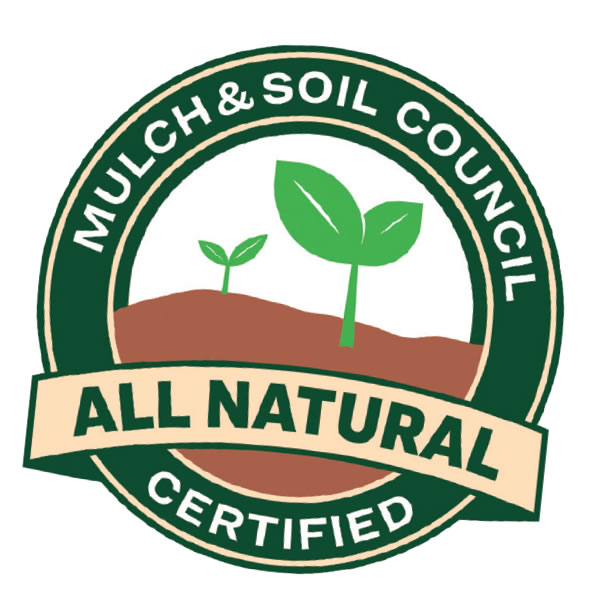
Jim Weber, who serves on the certification committee and is president of the MSC,
says the program will provide consumers with the assurance that mulches designated as
certified all-natural all meet the same demanding standards.
“I think it will be a great success,” Weber says, “I think it will help consumers on
which direction to go.”
An annual consumer survey conducted by MSC in June showed nearly half of the
1,421 respondents said they preferred a product identified as all-natural and organic.
“There are some things that are organic that aren't natural,” LaGasse notes. “So we
went the all-natural route . . . We're hoping this program will give consumers a more self-
explanatory, easily recognized indication of what they're purchasing.
“They're concerned about their kids’ exposure. They’re concerned about their pets’
exposure. They’re concerned about environmental issues,” he adds. “They don't want to
put things in their garden that will be a problem down the road.”
Weber said avid gardeners are more demanding these days on making sure that what
they put around their flowers, vegetables and other plantings “is what they expected it to
be.
“I think when people today are shopping for products, they're much more attuned to
looking for those that are all-natural,” says Weber, president of Ohio Mulch.
“Growing consumer interest in products free of recycled, treated, or synthetic inputs
drove the creation of a higher-level designation,” the MSC explains.
To meet that designation, mulches cannot contain any synthetic, artificial or
chemically treated materials. Also rejected are mulches containing any reprocessed or
recycled wood products, such as pallet grindings and construction and demolition debris.
Mulches that contain any inorganic or unnatural colorants, paints or stains are excluded
from the new certification program. Mulches must also be free from foreign matter above
0.2 percent by volume, which equates to 3 cubic feet, according to LaGasse.
To qualify for the new designation, mulch producers will first have to obtain the
council’s standard horticultural mulch certification. They can then (or at the same time)
apply for the all-natural mulch certification, which involves submitting product samples
for lab testing and undergoing subsequent quality audits and annual recertification.
Application, product testing and licensing fees will cost $1,050 for MSC members
and $2,100 for non-members.
Once approved, mulch manufacturers can print the MSC certified product logo and
the new certified all-natural trademark logo on their product bags.
“Together, these logos provide a transparent, instantly recognizable assurance of
standards compliance and natural integrity–empowering consumers in an underserved
market segment,” the MSC says.
Weber says some mulch manufacturers who today would not qualify for the all-
natural certification might alter their production processes in order to meet the new
requirements. Others who already offer all-natural products similar to Ohio Mulch might
also want to obtain certification to show consumers the new designation. Ohio Mulch
plans to apply for the new certification, Weber says.
The all-natural designation could prove to be a boon to mulch manufacturers, who
saw bagged sales decline in 2025 compared to two years earlier.
“I think we will see a shift in sales. I think it will boost sales for the people who have
the certification,” Weber predicts.
“If a consumer is going to a store to buy 50 bags of mulch, and one [product] is
certified as being all-natural and the other isn’t, that may be the deciding factor for
someone saying, ‘I want the all-natural.’”
LaGasse predicts that the all-natural designation will prove even more popular when
it is rolled out for soil products. That’s expected by the 2027 season.
“I think that it will be even more effective for soils because there is less
understanding of what's in a soil in the consumer market,” he says.
“If you’re in a store looking at soils and one is all-natural and another is not, I think
you’re more inclined to go with the all-natural than the one that isn't,” Weber adds. “You
don’t want to be putting down soil full of heavy metals or anything like that.”
Although the soil products certification plan has been in the works for several years,
mulches were rolled out first because they were less complex.
“You can make an all-natural mulch out of a limited number of items that can be
easily explained,” LaGasse explains. “There aren't many synthetic or unnatural
substitutes for them.”
Soils, however, are much more complicated.
“I've got a list of 103 terms that we would accept for soils,” he says.
Among issues being worked on for the soil program was the classification of
ingredients as “all-natural,” “conditional,” or “prohibited.”
LaGasse says the natural product market has been growing over the years.
“If you asked me 15 years ago, or even 10 years ago, if all-natural was going to take
over the market and would become a major thing, I probably would have said it's a niche.
It's more than niche now.”
Related News

Subscribe Today
Every other month, Soil & Mulch Producer
News brings you important stories about:
• New Technology
• Products
• Industry News
• Research Studies
Soil & Mulch Producer News features articles and services relevant to your daily operations.
Subscribe